Blog · EBYCELL® | Biotecnologia Agro
O microbioma sob nova luz: como o sequenciamento genômico está revolucionando o que sabemos sobre os micro-organismosThe microbiome in a new light: how genomic sequencing is revolutionizing what we know about microorganisms
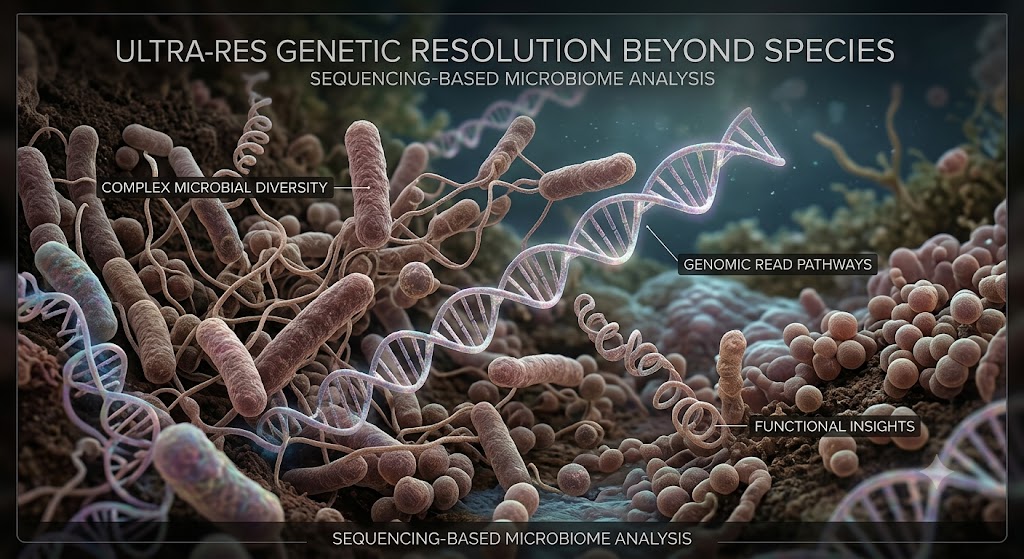
O microbioma sob nova luz: como o sequenciamento genômico está revolucionando o que sabemos sobre os micro-organismos
Por Dra. Marcia Mondin
Durante muito tempo, o universo invisível dos micro-organismos que habitam o solo, os oceanos e o corpo humano permaneceu em grande parte inacessível à ciência. Hoje, graças aos avanços do sequenciamento genético, estamos finalmente conseguindo enxergar esse mundo com uma nitidez sem precedentes — e as descobertas têm implicações profundas para a saúde, a agricultura e o meio ambiente.
Uma revisão publicada em 2024 na Nature Reviews Genetics, assinada pelos pesquisadores Yishay Pinto e Ami S. Bhatt, oferece um panorama abrangente de como essas tecnologias transformaram o estudo dos microbiomas. O trabalho reúne o que há de mais atual sobre os métodos que permitem investigar comunidades microbianas em um nível de detalhe que, até recentemente, seria impensável.
O que mudou
O grande salto veio de três frentes tecnológicas. Primeiro, o sequenciamento de DNA e RNA tornou-se mais barato e capaz de processar volumes muito maiores de dados. Segundo, as chamadas leituras longas (long-read sequencing) evoluíram, permitindo reconstruir genomas microbianos com mais fidelidade. E terceiro, surgiram métodos computacionais inovadores para dar sentido à imensa quantidade de informação gerada.
Combinadas, essas ferramentas permitem estudar os microbiomas em três dimensões complementares: a genômica (quais genes estão presentes), a transcricional (quais genes estão sendo ativados) e a translacional (quais proteínas estão de fato sendo produzidas). O resultado é uma compreensão muito mais funcional — não apenas quem está presente numa comunidade microbiana, mas o que esses micro-organismos estão realmente fazendo.
Por que isso importa
Talvez o aspecto mais empolgante desse avanço seja a resolução. Antes, a análise de microbiomas frequentemente parava no nível da espécie. Agora, é possível distinguir variações mais finas, chegando a diferenças entre cepas de uma mesma espécie. Isso abre portas para entender fenômenos como a transmissão de bactérias de mãe para filho, a resistência a antibióticos e a maneira como comunidades microbianas se adaptam ao longo do tempo.
Os microbiomas ocupam nichos extraordinariamente variados e desempenham papéis funcionais igualmente diversos. Na agricultura, influenciam a fertilidade e a estrutura do solo. Nas ciências ambientais, participam de ciclos essenciais à vida no planeta. E, na saúde humana, estão cada vez mais associados tanto ao equilíbrio do organismo quanto ao surgimento de doenças.
Um caminho ainda em construção
Apesar dos avanços, muito permanece desconhecido. Estudos recentes revelaram, por exemplo, que uma fração significativa das proteínas bacterianas presentes no intestino humano ainda não tem função conhecida — um lembrete de que estamos apenas começando a decifrar esse território. As novas tecnologias não apenas respondem perguntas antigas; elas revelam o tamanho daquilo que ainda ignoramos.
Para quem acompanha a área da saúde e das ciências da vida, a mensagem é clara: o estudo dos microbiomas deixou de ser uma fotografia estática de "quem está lá" para se tornar um retrato dinâmico e funcional de comunidades vivas em constante interação. É um campo em plena ebulição — e as próximas descobertas prometem redefinir a forma como entendemos a relação entre os micro-organismos e a vida como a conhecemos.
Referência: Pinto, Y. & Bhatt, A. S. Sequencing-based analysis of microbiomes. Nature Reviews Genetics 25, 829–845 (2024)
The microbiome in a new light: how genomic sequencing is revolutionizing what we know about microorganisms
By Dr. Marcia Mondin
For a long time, the invisible universe of microorganisms that inhabit the soil, the oceans and the human body remained largely inaccessible to science. Today, thanks to advances in genetic sequencing, we are finally able to see this world with unprecedented clarity — and the discoveries have profound implications for health, agriculture and the environment.
A review published in 2024 in Nature Reviews Genetics, by researchers Yishay Pinto and Ami S. Bhatt, offers a comprehensive overview of how these technologies have transformed the study of microbiomes. The work brings together the latest on the methods that make it possible to investigate microbial communities in a level of detail that, until recently, would have been unthinkable.
What has changed
The great leap came from three technological fronts. First, DNA and RNA sequencing became cheaper and able to process much larger volumes of data. Second, so-called long-read sequencing evolved, making it possible to reconstruct microbial genomes with greater fidelity. And third, innovative computational methods emerged to make sense of the immense amount of information generated.
Combined, these tools make it possible to study microbiomes in three complementary dimensions: the genomic (which genes are present), the transcriptional (which genes are being activated) and the translational (which proteins are actually being produced). The result is a much more functional understanding — not just who is present in a microbial community, but what these microorganisms are actually doing.
Why it matters
Perhaps the most exciting aspect of this advance is resolution. Previously, microbiome analysis often stopped at the species level. Now, it is possible to distinguish finer variations, down to differences between strains of the same species. This opens doors to understanding phenomena such as the transmission of bacteria from mother to child, antibiotic resistance and the way microbial communities adapt over time.
Microbiomes occupy extraordinarily varied niches and play equally diverse functional roles. In agriculture, they influence soil fertility and structure. In the environmental sciences, they take part in cycles essential to life on the planet. And in human health, they are increasingly associated with both the balance of the organism and the emergence of disease.
A path still under construction
Despite the advances, much remains unknown. Recent studies have revealed, for example, that a significant fraction of the bacterial proteins present in the human gut still have no known function — a reminder that we are only beginning to decipher this territory. The new technologies do not only answer old questions; they reveal the scale of what we still do not know.
For those who follow the fields of health and life sciences, the message is clear: the study of microbiomes has ceased to be a static snapshot of “who is there” to become a dynamic, functional portrait of living communities in constant interaction. It is a field in full ferment — and the next discoveries promise to redefine the way we understand the relationship between microorganisms and life as we know it.
Reference: Pinto, Y. & Bhatt, A. S. Sequencing-based analysis of microbiomes. Nature Reviews Genetics 25, 829–845 (2024)